Friday, October 14, 2011
That invisible fence sure is invisible!
But they don't.
The invisible fence stopped working. So now they go wherever they want. Lucky for us, they don't leave the property, but they sure are enjoying having the run of the place.
They hang out in the holly bushes in front of the house.
Friday, March 18, 2011
Tractor nostalgia
These are the kinds of tractors that were around where I grew up.See, it’s a lawn watering tractor.
You hook the back end to a hose, and set the track on the bottom over the hose in front.
Then the water going through the propellers pushes the tractor forward on the “track” (hose), watering the lawn with no work from you!
(Did I just say that a tractor has propellers? My farmer friends will laugh at me for that one!)
Even though the paint color is green, there are no logos on the tractor.
These days, I’m around tractors that look more like this.
And like this.
This tractor was borrowed, but it was still on our farm.
Sometimes the tractors look like this.
Then I laugh. Because it looks funny.
And because who would think I would end up living on a farm where I have no shortage of tractor pictures on me at all times?
Seriously. Have you met me? That’s pretty funny.
(Ahem. The mini-tractor pictures were taken with my shiny new camera. The other pictures were taken on a borrowed Nikon SLR, and have been featured on Farm Equipment Fridays.)
Hey! I almost forgot! I also have actually driven a tractor that looks like this: Can you guess which is my favorite?
Friday, November 12, 2010
Farm Equipment Fridays: Pressing Sweet Sorghum
(Miss the first part of the series? Learn about harvesting sweet sorghum first!)
Now that the sorghum is harvested, we must press it to get the sugary juice out of the middle of the stalk.The inside of the sorghum stalks looks kind of pulpy, and tastes sweet if you chew on it (yes, I did).
We want to press the stalks flat to squeeze all the sweet juice out of the pulpy middle.
First we take the sorghum stalks off the trailer we loaded yesterday
And load them onto the sorting table.
From there, the stalks are fed by hand into the tractor-driven press. Most of the dry leaves pass through the press, but a lot of them also fall off the stalks before they get to the press. By the end of the day, we were standing on a great cushion!
The stalks go through the rollers on the press
And, well, they get pressed. This press is a horizontal press, meaning the rollers are horizontal to the ground. Most presses are usually vertical.
The stalks come out smushed flat on the other side
And the juice comes pouring out the spout in the middle.
The squeezed stalks were taken away up a grain elevator
And into a really big pile. Eventually, these squeezed sorghum stalks (say that three times fast!) will be composted and used back for fertilizer. But squeezed sorghum stalks stick around for a while before they decompose.
Squeezed sorghum stalks. Squeezed sorghum stalks. Squeezed sorghum stalks.
Nevermind.
Anyway. The juice from the squeezed sorghum stalks is pumped from the collection basin into the big tank on the back of the truck. This tank holds 250 gallons. By the end of the day, it was full!
Then we all went home and went to bed. Only to get up and cook the juice into molasses the next day!
Instead of being driven by a tractor, presses used to be powered by horses.
The stalks were fed into the vertical press by hand, as the horse walked around and around and turned the rollers.
You just better be short enough so you don’t get hit in the head when the other side of the big stick comes around! Same basic principle as what we did last month, except our horse power came from a tractor. (These pictures are from Pioneer Village at the Indiana State Fair. I believe the Pepsi cup in the second photo is an anachronism. Oops.)
Oh, and here’s some proof that I actually helped with this part of the job, instead of just taking pictures.
Buddy, on the other hand, wasn’t much help at all. He was tired from all the harvesting yesterday, and hadn’t made it back from his sugar crash quite yet. Poor Buddy.
Next week – the finale!
This episode starred: Roy Boeglin, Cecil, me, and Buddy The Dog.
(Roy and Cecil can also be seen co-starring in the well saga.)
- Part 1: Harvesting sorghum
- Part 2: Pressing sorghum
- Part 3: Cooking sorghum
- Part 4: Making cookies!
Friday, November 5, 2010
Farm Equipment Fridays: Harvesting Sweet Sorghum
In October, hubby and I helped some friends harvest, press, and cook their sweet sorghum into
{I have recently been corrected. The resulting yummy concoction is not molasses. Molasses is a by-product of sugar manufacturing. Sweet sorghum syrup is the pure syrup from the sorghum stalk, after it has been boiled down, similar to maple syrup.}
Here begins the saga…
First, we had to harvest the sorghum. They have a relatively small sorghum field, only about half an acre.
You might think this looks a lot like corn stalks. You’d be right, it does. Corn and sorghum are both types of grasses (yep, that stuff that grows in your front yard).
Corn and sweet sorghum are both in the grass family, but are those “special” relatives. Corn grows this fantastic ear full of seed/grain/food, while sweet sorghum has a high sugar content in the stalk. Sorghum doesn’t grow an ear like corn does. Instead, it has all its seeds in the tassel on top of the plant.
(For some pictures of the different tassel on corn, check out Heather’s Farmer Friday feature at 3 Kids and Lots of Pigs.)
Sweet sorghum is usually harvested when the plant is more green than this. It has been so dry in Indiana this year that the sorghum is drying out earlier than normal. It’s the stalks we’re after, not the leaves or the seed heads, so things are still green enough.
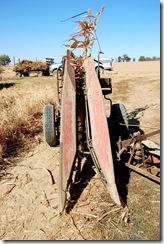
We used a piece of equipment called a corn bine for the harvest. (The tractor that pulls it is just out of the frame to the right.)
The tractor pulls the corn bine down each row of sweet sorghum.
The chains with the teeth pull the stalks up the corn bine toward the cutting edge, down below the chains.
Each stalk is cut, and held in a “shock” at the top of the corn bine.
When it was full, it automatically released the shock. It was John’s job to catch the shock and put it on the tractor that was following behind.
The corn bine was originally used to cut corn stalks and form shocks of corn. Now combines are used to harvest corn, and shocks are pretty much only used as fall decorations.
Buddy helped harvest. Or something. Apparently he likes sweet sorghum.
Once the tractor was full, we cut most of the seed heads off the sorghum stalks. This makes the pressing part easier later.
By the end of the harvest, there were three wagons full of sorghum stalks, ready for pressing.
Next up – pressing sweet sorghum!
This episode starred: my hubby John, Roy Boeglin (running the corn bine), Cecil (driving the trailer), and Buddy The Dog.
(Roy and Cecil can also be seen co-starring in the well saga.)
- Part 1: Harvesting sorghum
- Part 2: Pressing sorghum
- Part 3: Cooking sorghum
- Part 4: Making cookies!
Friday, October 29, 2010
Farm Equipment Fridays: Fertilizer
Last week we fertilized our hay fields and our pasture. (As with all the farming posts, I use the term “we” loosely. Mostly, I just took pictures.)
The best way to know exactly what type of fertilizer your ground needs is to check a soil sample for the nutrient balance. It has been so unbelievably dry in Indiana this summer that it’s too hard to get a good sample. Soil sampling is done by taking a “core” of dirt – think giant apple corer. Because it has been so dry, the ground is harder than normal, and it’s not easy to get a good core.
Soil testing is actually pretty important. Different crops have different nutritional needs. While we do know basically what these are, they can vary from year to year based on the growing conditions. Soil testing allows a farmer to know exactly what nutrients he needs to add to the soil. This means he’s not paying for something he doesn’t need. There’s no “extra” nutrition going into the soil that won’t be used by the plants and will end up as run off. Also, he’s not missing something which will result in poor crop growth next year.
So, this fall, we fertilized based on what grass hay typically takes out of the soil (the nutrients it needs to grow). Grass takes nutrients out, we put nutrients back in. Everyone’s happy, especially the cows!
The fertilizer is in this big bin. The bin is pulled by a bigger tractor.
We used half the planned amount of fertilizer this fall. In the spring, we will test the soil, and adjust the spring fertilizer mix based on the nutrients that are already present.
(Wondering why we didn’t wait until the spring and do it all then? We grow a “cool weather” grass, which means that it will grow in the late fall and early spring. In the spring, the fields will be too wet to drive a tractor on, but the grass will already be growing. All growing things need the right nutrition! So we gave it a half-dose, and will finish as soon as we can get in the fields in the spring.)
As the tractor drives through the field, the fertilizer is dropped out of the back of the bin, and onto this propeller-type wheel.
We used lime (calcium carbonate) and a mixture of 9% nitrogen, 23% phosphorous, and 30% potassium. (The other 38% is a carrier to dissolve the nutrients in.)
The lime is important to maintain the pH balance of the soil. (Remember high school chemistry?) As crops of any kind grow, they take basic substances out of the soil, and the soil gets acidic over time. Lime is a base (opposite of an acid), and replaces the bases that are incorporated into the plants, so the next round have some bases to work with. (This was done the day before the fertilizer, and I missed my photo op. Don’t worry. It looked the same.)
The wheel spins around and around, and flings the fertilizer out behind the tractor. See the lines of fertilizer that have been flung into the air?
The nitrogen, phosphorous, and potassium are also important nutrients for crops, but different crops need different amounts. For example, corn requires a lot of nitrogen for growth, but soybeans actually produce nitrogen and can replenish nitrogen in the soil. This is why many farmers will rotate soybeans in a field one year, and corn the next.
The cows don’t mind at all. They just keep on eating.
This one was actually more interested in me than in the big tractor rolling around her home.
Seriously. They were more curious about the tractor LEAVING than about it BEING THERE in the first place. These are some pretty laid-back cows!
Come back next week! We’re making sweet sorghum molasses! And there will be more pictures of Buddy the dog…
Friday, August 27, 2010
Farm Equipment Fridays: Round baler
Last we left Farm Equipment Fridays, we had finished raking the hay into windrows. Next comes the baler.
(This is a photo-heavy entry, so be a little patient. I promise, it’s worth it!)
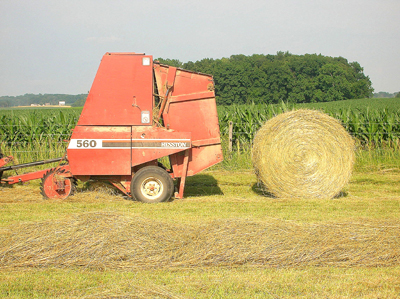
We use a round baler. This equipment makes, you guessed it, bales of hay that are round. There are other balers that make square bales. We may talk about those later. But, for now! The round baler!
The tractor drives over the newly raked windrows, and pulls the baler behind it. The baler has a rake at the bottom that rakes up all the hay from the windrow and throws it inside the baler.
There are conveyer belts inside the baler that roll the hay around and around and around inside. More hay gets added to the outside, sort of like a big snowball. This whole time, the conveyer belts are packing the “hay ball” tight.
When the baler is full, it beeps, and the tractor driver knows to stop. A full baler has a bale of hay that is about 5-1/2 feet in diameter.
Once the bale is made, it needs something to keep it together. We use string, but other people use plastic. The full bale is rolled around inside the baler some more, and the string is wrapped around the bale.
Once the bale is wrapped, the back door of the baler opens, and the bale falls out.
Pretty neat, huh?
The baler has a bar that pushes the completed bale away from the back of the equipment, so the door can shut again.
The bale rolls away a little bit, the door closes, and the baler moves on!
.
And we are left with bales of hay scattered around our field.
(Don’t worry, we’ll come back and pick them up later.)
Step 1 - Mower/conditioner
Step 2 - Tedder
Step 3 - Rake
Step 4 - Baler
Step 5 - Bale Spear