Showing posts with label sorghum. Show all posts

Sunday, November 10, 2013

Molasses Cookies

No comments:
I first posted this cookie recipe almost exactly three years ago! While there is nothing magical about baking theses cookies in the fall, it has become a sort of tradition for us. I don’t use regular molasses in these cookies – I use sorghum syrup. And we just happen to know some people who make sorghum syrup. And that always happens in the fall! So, every time we get a fresh batch of sorghum syrup, you guessed it, I bake these cookies!

molasses cookies with candle


Monday, November 22, 2010

Sorghum Cookies

6 comments:
As promised, here’s something to do with that sorghum!

I have been told that not all sorghum cookie recipes are the same.  I have also been told that this recipe is, hands down, the absolute best you will find anywhere. (And, for your viewing pleasure, check out this recipe redo post with better photos!)

I made a double batch of cookies over the weekend.  The recipe card at the bottom is for a single batch. 

Very simple ingredients.  All I had to go out and buy was ground ginger.  (And, frankly, I should have had some of that anyway.)

DSCN1382-1

Friday, November 19, 2010

Farm Equipment Fridays: Cooking Sweet Sorghum

2 comments:
FEF badge thumbnail Part 3 of 3 – you’re in the homestretch!

As you can imagine, it takes some doing to get the watery sweet juice from the squeezed sorghum stalks (sorry, I couldn’t resist.  I’m done now.) to turn into sorghum syrup.

The 250 gallons of juice we started with had a sugar content of 17 degrees on the Brix scale (which is 17% sugar).  The final syrup has around 80% sugar.  That’s a big jump!

To make this happen, we use this set up.DSC_0405-1

First, the sorghum juice sat in the settling tank overnight (this one actually isn’t the picture.)  Sorghum has a lot of calcium and other minerals in the juice.  These settle out overnight, which makes the heating later more even.

Then the juice is transferred into the preheating tank.  In this tank, the juice is heated to 180 degrees Fahrenheit, and then is let to cool off for 2 hours.  This helps with the later cooking process.  A lot of the impurities are boiled to the top and removed form the juice that eventually makes it into the big cooker.DSC_0405-2

The preheated juice is transferred with a pump to the holding tank.  This is just the reservoir to add to the cooker.DSC_0406-1

Then, the cooker.  This is a giant stainless steel pan with divisions that is heated from underneath.  Each division has a window on one end where the heated juice can travel from one section to the next.DSC_0405-3

 The juice is moved from the holding tank to the cooker by gravity.  On the way, it travels through the sponges in this bucket to filter out any solids that did not settle out overnight.DSC_0413-1

From there, into the cooker for some heat!
DSC_0417-1


DSC_0418-1
 Heat to boiling.DSC_0462-1

And skim off any of the impurities that come to the surface.DSC_0451-1

Hey, pay attention!DSC_0472-1

Who’s in charge here, anyway?DSC_0473-1

So, we’re heating the sorghum juice in the cooker.  As the water evaporates and the impurities are removed, the sugar content increases.  The cooker is hottest at the end where the juice enters.  As the sugar content increases, the juice becomes thicker, and moves away from the heat.  When things really get going, there is a distinct color difference from one end of the cooker to the other.

The starting end is only around 17% sugar, has a green color, and looks pretty watery.DSC_0479-1

The finishing end has a sugar content around 80%, is more brown, and has a much thicker consistency.DSC_0478-1

Once it starts looking like this, we check the sugar content periodically.  DSC_0600-1

When the sugar was between 78-83% (it varies a little with the temperature), we drained some of the finished syrup from the end of the cooker (through cheesecloth as another filter).DSC_0533-1

Then into the cooling tank for a little while.
DSC_0546-1


DSC_0559-1

Once the syrup was cooler, it was transferred (again through a cheesecloth filter)… DSC_0569-1

To the bottling tank (and one more filter).DSC_0579-1

And finally, into bottles, ready for use!DSC_0593-1

We wouldn’t let Buddy help.  He played with his ball for a while, and then took a nap.  Lucky dog.DSC_0454-1

The final syrup has a rich, dark brown color.  It is not quite as thick as molasses, and has a rich, slightly smokey, slightly bitter flavor.  WAY yummy.

Sweet sorghum syrup can be used as a syrup (like you would use maple syrup, but in smaller quantities), or in cooking by substituting equal volumes of syrup for sugar.  Next week I’ll post a sorghum syrup cookie recipe!

Interested in sorghum?  Want to learn more or try some?  Check out The National Sweet Sorghum Producers & Processors, or our friends Roy and Linda Boeglin (the stars of this series).  Roy and Linda have sweet sorghum molasses for sale at The Sorghum Barn in Haubstadt, Indiana.  Swing on by or call to order (they’ll ship within the United States):  (812) 768-6176.

This episode starred:  Roy and Linda Boeglin, my hubby John, and Buddy The Dog.
(Roy also can also be seen starring in the saga of the well.)

Friday, November 12, 2010

Farm Equipment Fridays: Pressing Sweet Sorghum

2 comments:
FEF badge thumbnail
(Miss the first part of the series?  Learn about harvesting sweet sorghum first!)

Now that the sorghum is harvested, we must press it to get the sugary juice out of the middle of the stalk.The inside of the sorghum stalks looks kind of pulpy, and tastes sweet if you chew on it (yes, I did).DSC_0230-1

We want to press the stalks flat to squeeze all the sweet juice out of the pulpy middle.DSC_0352-1

First we take the sorghum stalks off the trailer we loaded yesterdayDSC_0327-1

And load them onto the sorting table.DSC_0395-1

From there, the stalks are fed by hand into the tractor-driven press.  Most of the dry leaves pass through the press, but a lot of them also fall off the stalks before they get to the press.  By the end of the day, we were standing on a great cushion!DSC_0341-1

The stalks go through the rollers on the pressDSC_0386-1

And, well, they get pressed.  This press is a horizontal press, meaning the rollers are horizontal to the ground.  Most presses are usually vertical.

The stalks come out smushed flat on the other side DSC_0379-1

And the juice comes pouring out the spout in the middle.DSC_0376-1

The squeezed stalks were taken away up a grain elevatorDSC_0333-1

And into a really big pile.  Eventually, these squeezed sorghum stalks (say that three times fast!) will be composted and used back for fertilizer.  But squeezed sorghum stalks stick around for a while before they decompose.DSC_0355-1

Squeezed sorghum stalks.  Squeezed sorghum stalks.  Squeezed sorghum stalks.

Nevermind.

Anyway.  The juice from the squeezed sorghum stalks is pumped from the collection basin into the big tank on the back of the truck.  This tank holds 250 gallons.  By the end of the day, it was full!

Then we all went home and went to bed.  Only to get up and cook the juice into molasses the next day!

Instead of being driven by a tractor, presses used to be powered by horses.DSC_0378-1

The stalks were fed into the vertical press by hand, as the horse walked around and around and turned the rollers.DSC_0373-1

You just better be short enough so you don’t get hit in the head when the other side of the big stick comes around!  Same basic principle as what we did last month, except our horse power came from a tractor.  (These pictures are from Pioneer Village at the Indiana State Fair.  I believe the Pepsi cup in the second photo is an anachronism.  Oops.)

Oh, and here’s some proof that I actually helped with this part of the job, instead of just taking pictures.DSC_0311-1

Buddy, on the other hand, wasn’t much help at all.  He was tired from all the harvesting yesterday, and hadn’t made it back from his sugar crash quite yet.  Poor Buddy.DSC_0309-1

Next week – the finale!

This episode starred:  Roy Boeglin, Cecil, me, and Buddy The Dog.
(Roy and Cecil can also be seen co-starring in the well saga.)

Friday, November 5, 2010

Farm Equipment Fridays: Harvesting Sweet Sorghum

4 comments:
FEF badge thumbnail
In October, hubby and I helped some friends harvest, press, and cook their sweet sorghum into molasses syrup. 

{I have recently been corrected.  The resulting yummy concoction is not molasses.  Molasses is a by-product of sugar manufacturing.  Sweet sorghum syrup is the pure syrup from the sorghum stalk, after it has been boiled down, similar to maple syrup.}

Here begins the saga…

First, we had to harvest the sorghum.  They have a relatively small sorghum field, only about half an acre.DSC_0022-1

You might think this looks a lot like corn stalks.  You’d be right, it does.  Corn and sorghum are both types of grasses (yep, that stuff that grows in your front yard).  DSC_0032-1

Corn and sweet sorghum are both in the grass family, but are those “special” relatives.  Corn grows this fantastic ear full of seed/grain/food, while sweet sorghum has a high sugar content in the stalk.  Sorghum doesn’t grow an ear like corn does.  Instead, it has all its seeds in the tassel on top of the plant.DSC_0026-1

(For some pictures of the different tassel on corn, check out Heather’s Farmer Friday feature at 3 Kids and Lots of Pigs.)

Sweet sorghum is usually harvested when the plant is more green than this.  It has been so dry in Indiana this year that the sorghum is drying out earlier than normal.  It’s the stalks we’re after, not the leaves or the seed heads, so things are still green enough.DSC_0039-1

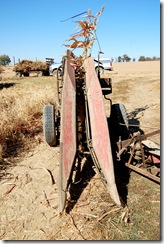
We used a piece of equipment called a corn bine for the harvest.  (The tractor that pulls it is just out of the frame to the right.)DSC_0102-1

The tractor pulls the corn bine down each row of sweet sorghum.   DSC_0132-1

The chains with the teeth pull the stalks up the corn bine toward the cutting edge, down below the chains.DSC_0134-1

Each stalk is cut, and held in a “shock” at the top of the corn bine.DSC_0260-1

When it was full, it automatically released the shock.  It was John’s job to catch the shock and put it on the tractor that was following behind.
DSC_0262-1

DSC_0265-1

The corn bine was originally used to cut corn stalks and form shocks of corn.  Now combines are used to harvest corn, and shocks are pretty much only used as fall decorations.

Buddy helped harvest.  Or something.  Apparently he likes sweet sorghum.DSC_0209-1

Once the tractor was full, we cut most of the seed heads off the sorghum stalks.  This makes the pressing part easier later.DSC_0121-1

By the end of the harvest, there were three wagons full of sorghum stalks, ready for pressing.DSC_0012-1

Next up – pressing sweet sorghum! 

This episode starred:  my hubby John, Roy Boeglin (running the corn bine), Cecil (driving the trailer), and Buddy The Dog.
(Roy and Cecil can also be seen co-starring in the well saga.)
Real Time Web Analytics