Tuesday, November 30, 2010

What I did on Black Friday

6 comments:

In no particular order.

Cleaned off my desk.

clean desk

Two loads of laundry.

laundry

Four rounds of dishes (still no new dishwasher).

clean dishes

Personal and professional goal setting for 2011 (and then some).

Emailed an old friend.

Read everything in my Google Reader account.

Brined a turkey.

turkey brine

Fried a turkey.  Again.  Seriously.

turkey fryer

Fried hush puppies.  (Hey, we had all that hot oil!)

Drank a whole pot of coffee.  By myself.  And I loved it.

full coffee

Wrote an abstract of my PhD research.

Updated the checkbook and our budget.  (Note, did not balance the checkbook.)

Cyber Monday?  I went shopping.  (Seriously?  What was I thinking?)

Monday, November 22, 2010

Sorghum Cookies

6 comments:
As promised, here’s something to do with that sorghum!

I have been told that not all sorghum cookie recipes are the same.  I have also been told that this recipe is, hands down, the absolute best you will find anywhere. (And, for your viewing pleasure, check out this recipe redo post with better photos!)

I made a double batch of cookies over the weekend.  The recipe card at the bottom is for a single batch. 

Very simple ingredients.  All I had to go out and buy was ground ginger.  (And, frankly, I should have had some of that anyway.)

DSCN1382-1

Friday, November 19, 2010

Farm Equipment Fridays: Cooking Sweet Sorghum

2 comments:
FEF badge thumbnail Part 3 of 3 – you’re in the homestretch!

As you can imagine, it takes some doing to get the watery sweet juice from the squeezed sorghum stalks (sorry, I couldn’t resist.  I’m done now.) to turn into sorghum syrup.

The 250 gallons of juice we started with had a sugar content of 17 degrees on the Brix scale (which is 17% sugar).  The final syrup has around 80% sugar.  That’s a big jump!

To make this happen, we use this set up.DSC_0405-1

First, the sorghum juice sat in the settling tank overnight (this one actually isn’t the picture.)  Sorghum has a lot of calcium and other minerals in the juice.  These settle out overnight, which makes the heating later more even.

Then the juice is transferred into the preheating tank.  In this tank, the juice is heated to 180 degrees Fahrenheit, and then is let to cool off for 2 hours.  This helps with the later cooking process.  A lot of the impurities are boiled to the top and removed form the juice that eventually makes it into the big cooker.DSC_0405-2

The preheated juice is transferred with a pump to the holding tank.  This is just the reservoir to add to the cooker.DSC_0406-1

Then, the cooker.  This is a giant stainless steel pan with divisions that is heated from underneath.  Each division has a window on one end where the heated juice can travel from one section to the next.DSC_0405-3

 The juice is moved from the holding tank to the cooker by gravity.  On the way, it travels through the sponges in this bucket to filter out any solids that did not settle out overnight.DSC_0413-1

From there, into the cooker for some heat!
DSC_0417-1


DSC_0418-1
 Heat to boiling.DSC_0462-1

And skim off any of the impurities that come to the surface.DSC_0451-1

Hey, pay attention!DSC_0472-1

Who’s in charge here, anyway?DSC_0473-1

So, we’re heating the sorghum juice in the cooker.  As the water evaporates and the impurities are removed, the sugar content increases.  The cooker is hottest at the end where the juice enters.  As the sugar content increases, the juice becomes thicker, and moves away from the heat.  When things really get going, there is a distinct color difference from one end of the cooker to the other.

The starting end is only around 17% sugar, has a green color, and looks pretty watery.DSC_0479-1

The finishing end has a sugar content around 80%, is more brown, and has a much thicker consistency.DSC_0478-1

Once it starts looking like this, we check the sugar content periodically.  DSC_0600-1

When the sugar was between 78-83% (it varies a little with the temperature), we drained some of the finished syrup from the end of the cooker (through cheesecloth as another filter).DSC_0533-1

Then into the cooling tank for a little while.
DSC_0546-1


DSC_0559-1

Once the syrup was cooler, it was transferred (again through a cheesecloth filter)… DSC_0569-1

To the bottling tank (and one more filter).DSC_0579-1

And finally, into bottles, ready for use!DSC_0593-1

We wouldn’t let Buddy help.  He played with his ball for a while, and then took a nap.  Lucky dog.DSC_0454-1

The final syrup has a rich, dark brown color.  It is not quite as thick as molasses, and has a rich, slightly smokey, slightly bitter flavor.  WAY yummy.

Sweet sorghum syrup can be used as a syrup (like you would use maple syrup, but in smaller quantities), or in cooking by substituting equal volumes of syrup for sugar.  Next week I’ll post a sorghum syrup cookie recipe!

Interested in sorghum?  Want to learn more or try some?  Check out The National Sweet Sorghum Producers & Processors, or our friends Roy and Linda Boeglin (the stars of this series).  Roy and Linda have sweet sorghum molasses for sale at The Sorghum Barn in Haubstadt, Indiana.  Swing on by or call to order (they’ll ship within the United States):  (812) 768-6176.

This episode starred:  Roy and Linda Boeglin, my hubby John, and Buddy The Dog.
(Roy also can also be seen starring in the saga of the well.)

Tuesday, November 16, 2010

Toast! French Toast!

8 comments:

Unfortunately, I was not able to join the girls last weekend at the Freeze-O-Rama cookathon.  It looks like they had a blast!  I did, however, cook up a monster batch of French toast to fill my freezer!

Chilled thumbnail

This is, by far, my very favorite French toast recipe.  Ever.  It’s an Alton Brown recipe (if you've never seen his show, Good Eats, you are missing out!), and I love it.  This is pretty much the only cooking show I watch.  He makes cooking science, and that I can relate to!

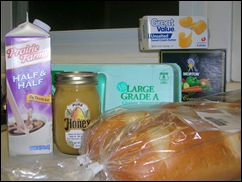
Anyway…  The French toast…  Here’s the players:DSCN1348-1

I made a quadruple batch (with the help of loving hubby), so the volumes here are huge.  It cooks up just fine in a single batch, too!

I do all the prep work the night before.  Start with two loaves of French bread (or Brioche, or Challah, something fluffy with great texture).  I slice it up the night before and leave it out to get just a touch dry.  I think it soaks up less of the egg mixture and gets less soggy this way.DSCN1351-1

Then, crack 12 large eggs in a mixing bowl and scramble them up.DSCN1353-1

(Quadruple batch = a dozen eggs.  Yikes!)

Then add 1 quart (4 cups) of half-and-half and whisk together.DSCN1356-1

Next, warm 8 tablespoons of honey in the microwave for a few seconds (just enough so it pours easily).  Add the honey and 1 teaspoon of salt to the egg mixture. DSCN1358-1

Cover the custard and refrigerate overnight.

The next morning, when you’re good and hungry, preheat the oven to 375 degrees F (trust me!) and pour the custard into a flat pan or two. (AB recommends a pie pan.  My pie pans are stoneware, and I wasn’t a fan of this in the porous stone.  So I used plastic dipping trays instead, and they worked great!)DSCN1364-1 

Soak the bread in the custard for about 30 seconds on each side.DSCN1366-1

Then let it drain on a cooling rack laid over a cookie sheet for 1-2 minutes.  Let that custard really soak in! DSCN1361-1

Melt a good hunk of butter in a frying pan.  We used our handy cast-iron griddle for this, mostly because of the huge volume of French toast we were making!  (And because hubby looks for any excuse to use it.)

Cook the French toast for 2-3 minutes on each side, until GBD (golden brown delicious).DSCN1374-1

After both sides are done, bake the French toast in the oven for 5 minutes.DSCN1376-1

This is the step that makes the biggest difference in the French toast world!  (Well, in my kitchen, anyway).  It comes out just a hint crisp on the outside, still nice and crusty, and perfectly soft in the middle, without being soggy.  My favorite!

Serve immediately, with your choice of toppings.  My favorite is always real maple syrup.  (And wasn’t this New England transplant surprised to find great real maple syrup made right here in Indiana!)  DSCN1377-1

Mmmm…  Sugar coma…

I freeze the cooled finished product in zip-top freezer bags.  I use parchment or wax paper between the layers of toast, otherwise they stick together and are way too hard to pull apart when it’s frozen.  And that is not Good Eats. DSCN1381-1

To reheat, just take out of the freezer and pop in the toaster, toaster oven, or regular oven for a few minutes until warmed through!  Ta da, French toast in an instant!

The recipe card has the quantities for a single batch…  Simply multiply as needed!French toast recipe card

Now go have some great breakfast!!

Monday, November 15, 2010

You ARE creative!

2 comments:

Thanks to everyone for your suggestions over the last week.  I had lots of great name options, here and at my WordPress blog (mirror site). 

All the names were great, and it was tough choosing my favorite.  I had my hubby chime in on the options.

My favorite suggestion was “AgriCulturing” by Kerry.  I love the idea of that!  The trouble is, the domain name “agriculturing.com” is not available.  All that is posted there right now is “coming soon,” and I don’t have a guess as to what will be there in the future, so I am hesitant to go for “agriculturing.net.” 

A very close second was Jessica’s idea of using the word “raising” in the name somewhere, to pull in the idea of raising food and raising families.  I also love that idea!

So, two winners!  Kerry and Jessica, please email me at alarmclockwars at gmail dot com and let me know where you want your Starbucks gift cards sent!

Now…  I’ve been brainstorming over the last week, and my current choice for a name for this budding business is “Farmers Raising Families.”  Any other brilliant ideas on this?

Thanks so much for all your help…  I had a ball reading the names as they came in!

Real Time Web Analytics